

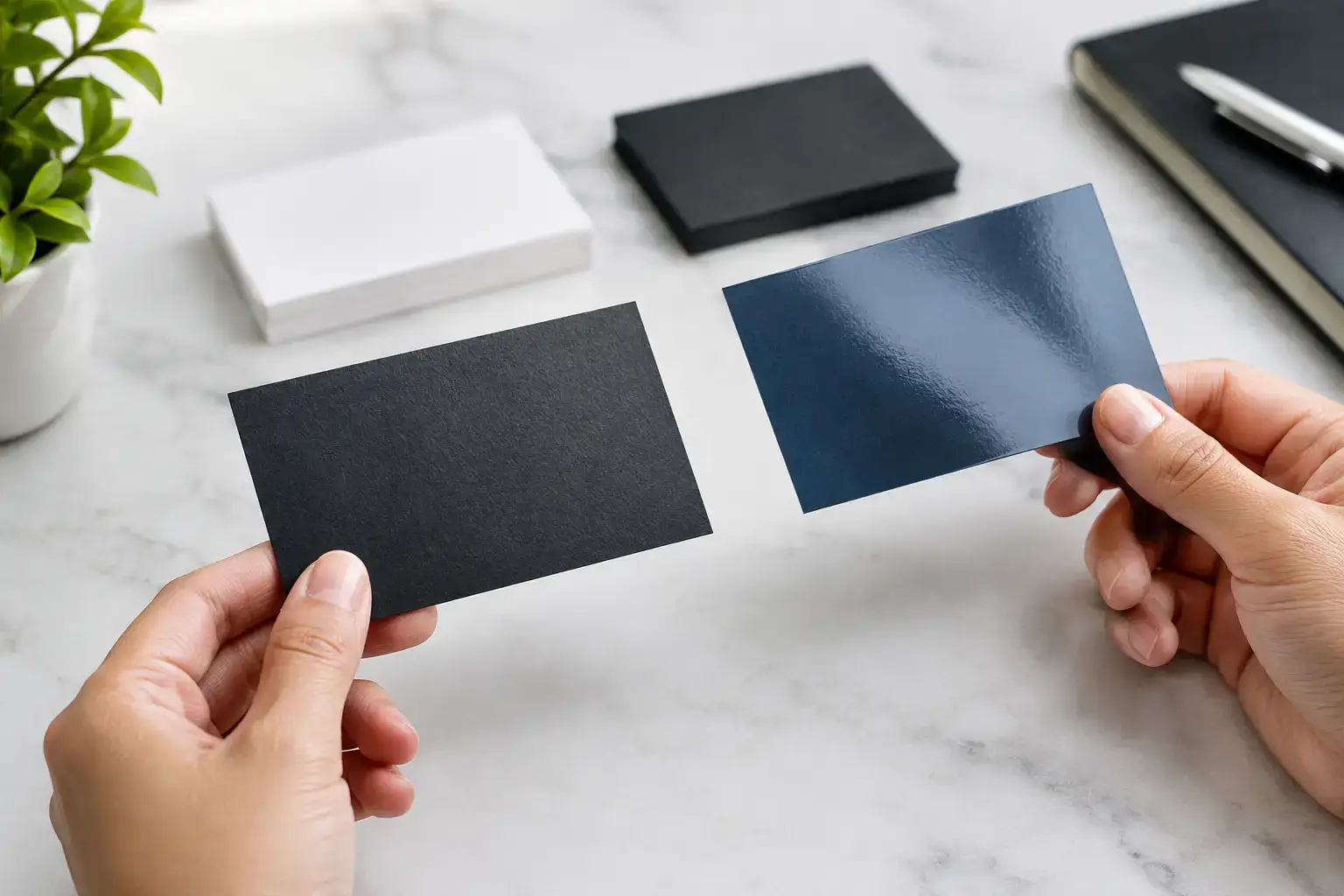
A business card spends very little time sitting still. It is passed across counters, carried in wallets, stacked in desk drawers, and handled at events. When customers ask what finish makes business cards durable, the answer is usually lamination – but the best option depends on how often the card will be handled, the brand look, and the budget.
For most everyday business use, a laminated card on a quality cardstock gives the best balance of protection, print appearance, and cost. Specialty finishes such as velvet lamination, spot UV, embossing, or PVC can add impact, but they do not all solve the same durability problem.
What Finish Makes Business Cards Durable for Daily Use?
Matte or gloss lamination is the most practical finish for durable paper business cards. A thin protective film is applied over the printed surface, helping reduce scuffs, fingerprints, light moisture damage, and fading from repeated handling. It also makes the card less likely to show wear at the edges than an uncoated card.
A laminated business card is a solid choice for retail staff, sales teams, real estate agents, contractors, restaurants, event businesses, and anyone distributing cards regularly. It holds up better in a pocket or wallet and keeps colors looking cleaner after multiple handoffs.
The paper stock underneath still matters. Lamination protects the face of the card, but a lightweight card can still bend or crease. For a professional, durable result, pair lamination with a heavier stock such as 14 pt, 16 pt, or 350 GSM cardstock. Higher GSM generally means a thicker, more substantial sheet, though thickness can vary by paper type.
Matte Lamination: The Best All-Around Choice
Matte lamination has a smooth, non-shiny surface. It is widely used for professional business cards because it looks clean, reduces glare, and does a good job hiding fingerprints and small surface marks. It works especially well for corporate cards, service businesses, consultants, law offices, healthcare providers, and premium retail brands.
From a durability standpoint, matte lamination protects the print while keeping the design readable under indoor lighting and sunlight. Fine text, QR codes, and muted brand colors often look more controlled on a matte surface than on a highly reflective finish.
There is a trade-off. Matte colors can appear slightly softer than gloss colors, particularly on large solid color areas. If the design depends on bright photos, vivid product shots, or bold color contrast, gloss may provide more visual punch. For most standard business cards, however, matte lamination is the safest all-purpose specification.
When to choose matte lamination
Choose matte lamination when the card needs frequent handling, understated branding, and easy readability. It is also a good base for premium add-ons such as spot UV or embossing because the contrast between the flat matte surface and the raised or glossy detail is easy to see.
Gloss Lamination: Strong Protection and Brighter Color
Gloss lamination provides similar surface protection to matte lamination but adds a polished shine. It makes photographs, saturated colors, gradients, and image-heavy artwork appear brighter. This makes it a practical fit for beauty businesses, food brands, entertainment, retail promotions, automotive services, and creative portfolios.
Gloss is durable, easy to wipe clean, and more resistant to moisture than an uncoated paper card. If a card will be displayed at a counter, included in packaging, or handed out in high volume, gloss can keep the print looking fresh.
The main limitation is glare. Glossy cards can reflect overhead light, and fingerprints may be more visible on dark or solid-color designs. It can also be harder to write on a gloss surface. If you plan to add appointment details, notes, or a handwritten expiration date, consider leaving an uncoated writable area or selecting a matte finish instead.
Velvet Lamination: Premium Feel With Everyday Protection
Velvet lamination, sometimes called soft-touch lamination, has a smooth, suede-like feel. It gives business cards a high-end tactile finish while adding a protective laminated layer. It is popular for luxury services, salons, interior designers, high-end restaurants, photographers, architects, and brands that want the card itself to feel memorable.
Velvet is durable for normal handling, but it needs the right design and expectation. Very dark velvet cards can show oils or fingerprints more easily than lighter designs, especially after heavy handling. The surface is still protected, but visible marks may require gentle wiping.
For a premium card that will not be distributed by the hundreds every day, velvet lamination is a strong option. It is especially effective when combined with spot UV on a logo, name, or pattern. The contrast creates a card that looks intentional without overcrowding the design.
Spot UV and Embossing Add Impact, Not Full Protection
Spot UV is a clear glossy coating applied only to selected areas, such as a logo, headline, icon, or design pattern. Embossing raises a design element above the card surface. Both finishes improve presentation and help a card stand out in a stack, but neither should be chosen as the primary durability finish.
Use spot UV over a laminated base, usually matte or velvet, for the best result. The lamination protects the overall card while spot UV provides a visual highlight. Applying spot UV to an uncoated card may look attractive at first, but the rest of the printed surface remains more exposed to scuffs and moisture.
Embossing is also best treated as a design upgrade. Raised details can flatten slightly over time if cards are tightly packed in wallets or pressed under other materials. A well-produced embossed card remains professional, but it is not the best option when maximum resistance to rough handling is the only priority.
PVC Cards Are the Most Durable Option
If the card needs to survive frequent physical use, PVC is stronger than paper stock with any laminated finish. PVC business cards are made from plastic, similar to membership cards, loyalty cards, access cards, or ID cards. They resist water, tearing, bending, and everyday surface wear far better than standard paper cards.
PVC works well for gyms, clubs, salons, schools, membership programs, loyalty schemes, and businesses that want a reusable card with a longer lifespan. It can also be a practical choice for tradespeople and outdoor service providers whose cards may be exposed to moisture, dirt, or tools.
PVC has its own trade-offs. It costs more than standard cardstock, can feel less traditional as a business card, and is not always the best fit for brands that want a natural paper texture or an easy-to-write surface. It is best used when durability is a functional requirement, not just a preference.
Match the Finish to How the Card Will Be Used
The right finish is easier to choose when you start with the card’s working environment. A card handed out occasionally during client meetings has different needs from one carried by delivery staff or used as a loyalty card.
For a dependable standard card, select 14 pt or 16 pt cardstock with matte lamination. For brighter retail or image-led designs, choose gloss lamination. For a premium hand-feel, use velvet lamination and add spot UV only where it supports the design. For repeat-use cards exposed to water, bending, or heavy handling, PVC is the practical upgrade.
Avoid selecting a finish only because it looks impressive on screen. A glossy black card may look striking but show fingerprints. An embossed design may feel premium but lose definition in a crowded wallet. A thick uncoated card may feel substantial but pick up marks quickly. The best specification balances appearance with the real conditions your customers and staff face.
Design Details That Help Business Cards Last Longer
Durability also comes from smart artwork setup. Keep important text and logos away from the trim edge so minor edge wear does not affect readability. Avoid large dark ink areas if cards will see heavy use, since scuffs can be more noticeable on black, navy, or deep solid colors.
Use high-resolution artwork and allow proper bleed around the edges. A durable finish cannot fix blurry logos, weak color files, or a design that is too close to the cut line. If the card includes a QR code, make sure it has enough clear space around it and test it before printing.
For brands ordering multiple items at once, consistent finishing matters too. Matching business cards with brochures, postcards, stickers, menus, or packaging creates a more organized brand presentation. Seaonce offers finish and material options that help businesses keep these everyday print pieces aligned.
A business card should feel right when it is handed over and still look right after it has spent a week in a wallet. For most businesses, matte or gloss lamination on heavy cardstock delivers that result without adding unnecessary cost. Save PVC, velvet, spot UV, and embossing for situations where the use case or brand experience gives them a clear job to do.
Your comment is awaiting moderation.
Вы мечтаете о уютном и экологически чистом жилище? Рассмотрите возможность строительства [url=https://karkasnye-doma-spb12.ru]каркасный дом санкт петербург[/url] — современные решения, которые идеально подходят для комфортной жизни в Санкт-Петербурге.
Строительство каркасных домов набирает популярность среди людей, выбирающих современные технологии .
Каркасные дома привлекают своими короткими сроками строительства и доступной ценой .
В основе каркасных домов лежит опорная рама, которая может быть изготовлена из различных материалов.
Благодаря особенностям конструкции, каркасные дома обладают отличной тепло- и звукоизоляцией .
Каркасные дома отлично подходят для климатических условий с холодными зимами и жарким летом .
Наружная отделка, в свою очередь, служит дополнительной защитой и придает дому эстетичный вид.
В отличие от других видов, такие дома возводятся за минимальные сроки, что экономит деньги и время .
Уход за каркасным домом предполагает регулярную проверку и обслуживание его внешних элементов .
Такой вид строительства идеально подходит для тех, кто хочет быстро получить уютный и надежный дом.