

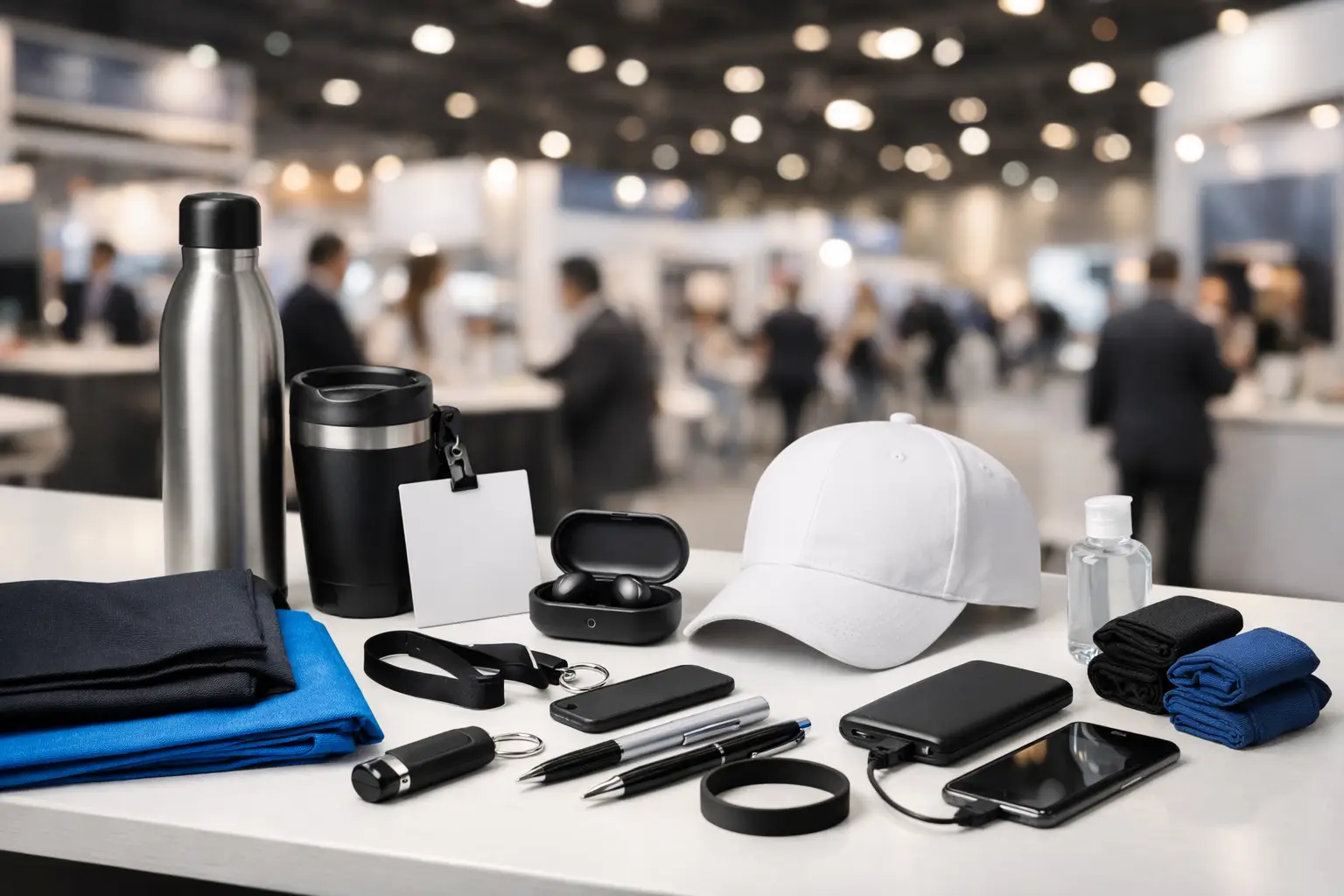
A crowded trade show floor gives visitors seconds to decide whether to stop. The best promotional items for trade shows help your brand stay visible after that quick conversation, but only when the item is useful, clearly branded, and appropriate for the audience. A low-cost giveaway may build volume, while a higher-value item can support stronger conversations with qualified leads.
The right choice depends on your booth traffic, event type, budget, and sales goal. A restaurant opening a new location needs a different giveaway than a software company booking product demos or a construction supplier meeting purchasing managers. Start with the use case, then select the product, print method, and quantity.
What Makes a Trade Show Giveaway Worth Keeping?
A promotional item does not need to be expensive to work. It needs to earn a place in a bag, on a desk, or in a vehicle. The most effective items solve a small everyday problem: carrying materials, taking notes, charging a device, opening a package, or holding a drink.
Branding should be visible without overwhelming the product. Use a clean logo, one readable contact point, and colors that reproduce well on the selected material. Small products have limited print space, so avoid placing every service, social handle, and phone number on one item. A QR code can be useful when it leads to a specific offer, catalog, booking page, or event-only promotion.
Quantity also changes the buying decision. If your booth expects 1,500 visitors, a premium metal tumbler for everyone is usually not practical. Use affordable handouts for general traffic and reserve higher-value products for scheduled meetings, decision-makers, contest winners, or prospects who complete a product demo.
Best Promotional Items for Trade Shows by Use Case
1. Branded Tote Bags
Custom tote bags are among the strongest trade show products because attendees need them immediately. Visitors collect brochures, samples, catalogs, and cards throughout the day, and a useful bag can carry your logo across the exhibit hall.
Choose non-woven bags for high-volume distribution and value-focused campaigns. Cotton canvas or heavier reusable bags suit premium events, retail brands, and businesses that want longer-term use. Print a bold logo on one side and keep the artwork large enough to read from several feet away. A tote bag also works well when paired with a brochure, sticker sheet, postcard offer, or product catalog.
2. Custom Pens
Pens remain a practical choice for conferences, training events, education fairs, and business expos. They are compact, affordable, and easy to hand out without slowing down booth traffic. The trade-off is that pens are common, so quality matters. A pen that writes smoothly feels more valuable than the lowest-cost option.
Use simple branding with a logo, business name, and website or phone number. For a more polished presentation, add pens to a small notebook, folder, or welcome packet for pre-booked meetings.
3. Notebooks and Notepads
Branded notebooks and notepads work especially well when attendees are taking notes during sessions, product presentations, or buyer meetings. They offer a larger branding area than a pen and remain useful after the event.
Small notepads are effective for broad distribution. Hardcover notebooks, spiral notebooks, and branded journals are better for priority prospects and corporate gift sets. Consider adding an event-specific cover message, such as a consultation offer or a product launch theme, rather than using generic artwork alone.
4. Reusable Water Bottles and Tumblers
Drinkware has high perceived value and a long usable life. A well-made branded tumbler can remain on a desk for months, keeping your business name in regular view. It is a strong option for fitness, hospitality, real estate, professional services, and corporate events.
This category needs careful budget control. Drinkware costs more than pens, stickers, or key chains, and it takes more storage space at the booth. Use it as a lead qualification incentive: offer it after a meeting is booked, a purchase inquiry is submitted, or a visitor completes a meaningful conversation with your team.
5. USB Drives
Custom USB drives are still relevant for businesses that distribute catalogs, portfolios, training files, construction drawings, product specifications, or presentations. They can feel more substantial than a paper handout, especially when packaged with a branded card or small box.
However, they are not the best choice for every industry. Many prospects prefer cloud-based access, and some corporate IT policies restrict external drives. If you use USBs, load only current, useful files and include a printed URL or QR code as a backup. Do not rely on the drive as the only way to access your information.
6. Key Chains and Keyrings
Key chains are inexpensive, compact, and easy to customize. They fit automotive businesses, property management companies, hotels, retailers, insurance agencies, and service providers particularly well. A key chain with an added function – such as a bottle opener, tape measure, flashlight, or trolley token – has more reason to stay in use.
Keep the design simple. Fine text and detailed graphics can disappear on small surfaces. A logo and short brand name are usually enough.
7. Custom Stickers
Stickers are one of the most flexible low-cost trade show items. They work for retail brands, food businesses, creative services, schools, community events, and startup campaigns. Die-cut stickers can feature a product shape, mascot, slogan, or logo, making them more memorable than a standard square label.
Stickers are most effective when they are designed as something attendees would actually place on a laptop, water bottle, packaging, or notebook. A plain logo sticker can work, but a well-designed graphic with personality often gets better use. Include them in giveaway packs, attach them to product samples, or offer multiple designs at the booth.
8. Branded Caps and T-Shirts
Apparel creates high visibility, both at the trade show and afterward. Branded caps, polo shirts, and T-shirts are useful for booth staff, giveaways, contests, and customer appreciation. They are also ideal when your brand has a recognizable visual identity that people would be comfortable wearing.
Sizing makes apparel less suitable for unrestricted handouts. Caps are easier because they are one-size items, while T-shirts require size management and more booth inventory. For staff uniforms, consistent apparel helps visitors identify your team quickly in a busy hall.
9. Phone Accessories
Phone stands, charging cables, card holders, screen cleaners, and wireless charging products address everyday needs. They suit technology, financial services, healthcare, education, and office-focused brands. Smaller accessories are easy to pack and can carry a simple logo without requiring a large booth footprint.
Check product quality before ordering in volume. A cable that fails or a phone stand that feels unstable can create the wrong impression. For higher-value electronics, use a smaller distribution quantity and reserve them for qualified prospects.
10. Branded Mugs
Ceramic mugs are a dependable office giveaway for local businesses, professional firms, and repeat customer programs. They offer a large print area and daily visibility in office settings. They are less convenient for events where visitors travel by air or walk long distances, since they are heavier and breakable.
Use mugs when the expected audience is local, when attendees can carry items easily, or when you plan to ship follow-up gift packs after the show. For an exhibit hall giveaway, tumblers or lightweight drinkware may be more practical.
11. Product Samples and Branded Packaging
For food, beauty, retail, wellness, and consumer product businesses, the product itself is often the best promotional item. A small sample in branded packaging gives prospects a direct experience of what you sell. Add a sticker, printed sleeve, insert card, or promotional coupon to make the sample easy to identify later.
This approach requires planning around event rules, shelf life, food handling, and transport. But when the sample is relevant and well presented, it can produce stronger recall than a generic giveaway.
12. Business Cards, Postcards, and Offer Cards
Printed collateral is not a giveaway in the traditional sense, but it remains essential. A well-designed business card provides direct contact details. A postcard can feature a limited-time event offer. A folded brochure can explain product ranges, specifications, pricing tiers, or service areas.
Use premium finishes strategically. Velvet lamination gives a soft, upscale feel, while spot UV can highlight a logo or key image. Embossing and thick stock can make a business card more memorable, but they are best reserved for brands where presentation supports the sale. For high-volume handouts, standard full-color cards or flyers keep costs under control.
Build a Giveaway Mix Instead of Ordering One Item
A practical booth usually needs more than one promotional product. Use an open-access item for general visitors, a printed piece that explains the offer, and a premium item for qualified leads. This prevents expensive inventory from being taken by people who have no buying interest while still giving every visitor something useful.
For example, a local retailer may distribute die-cut stickers and postcards to walk-up traffic, then offer branded tote bags to visitors who join a loyalty program. A B2B service company may use pens and notepads for general conversations, then provide premium notebooks or tumblers after a scheduled consultation. The product mix should match the value of the next step you want visitors to take.
Check Print Details Before You Order
Promotional merchandise is only as effective as the artwork and production details. Confirm the available print area, number of print colors, item color, and print method before finalizing the design. Screen printing is common for apparel and bags, while sublimation is useful for full-color items such as certain mugs and textile products. Small-format products may need simplified artwork to maintain readability.
Order enough for expected traffic plus a modest buffer, but avoid overbuying a dated event design. Keep event names and dates off higher-cost items whenever possible so leftover inventory can be used later. For printed cards, flyers, and stickers, event-specific messaging is easier to refresh and reorder.
Seaonce can help simplify this procurement by combining promotional merchandise with business cards, brochures, stickers, banners, roll-up displays, and staff apparel in one order. The goal is not to give away the most items. It is to put a useful, professional branded item in the hands of people most likely to remember your business and act on the next step.