

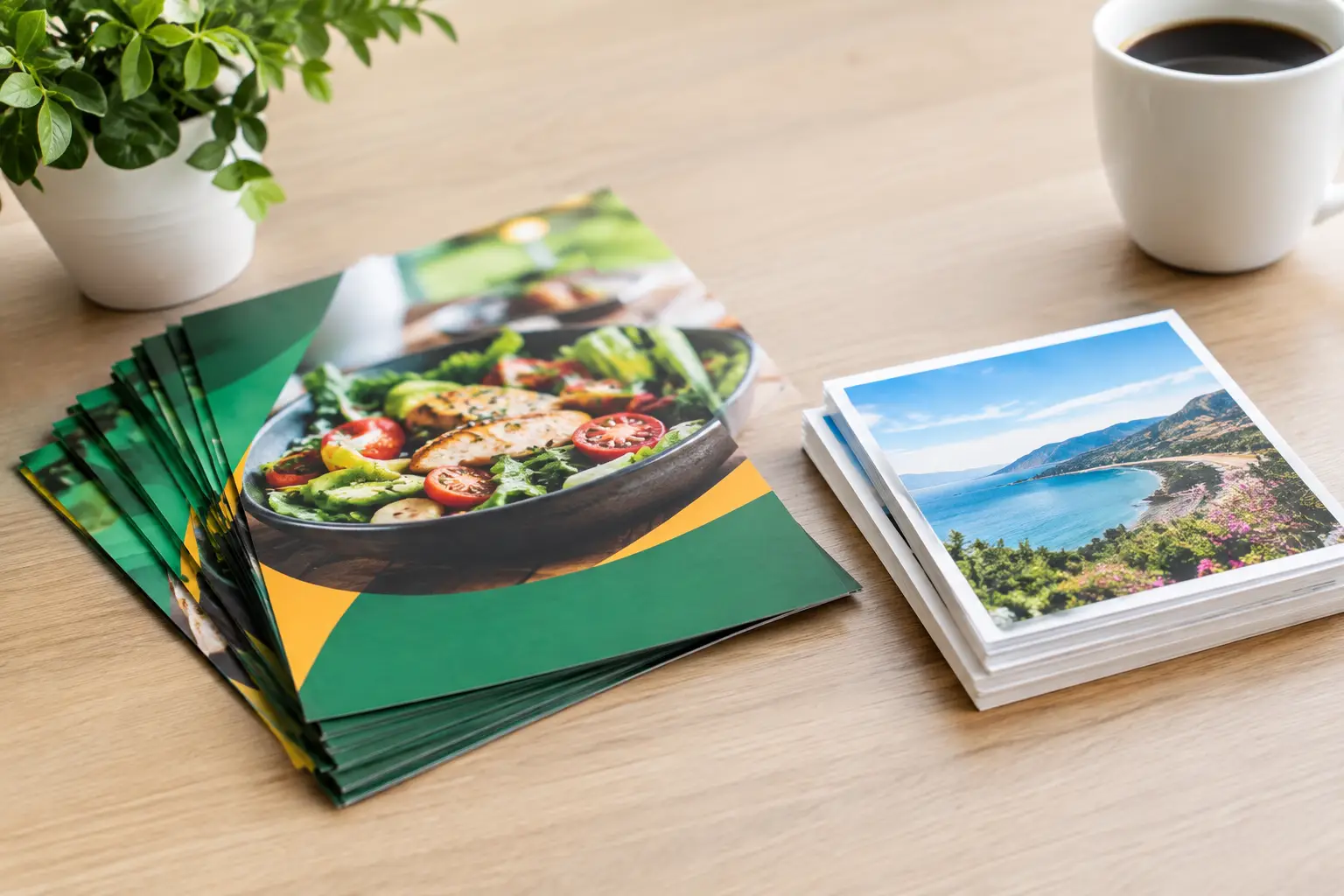
A restaurant running a lunch special, a salon filling weekday appointments, and a realtor promoting an open house may all need printed promotion – but they do not need the same format. In flyers vs postcards marketing, the right choice comes down to how much information you need to communicate, where the piece will be distributed, and what action you want customers to take.
Flyers give you more room to explain an offer, show products, list services, or promote an event schedule. Postcards are compact, direct, and built for mailing or hand delivery when a short message and a strong offer are enough. Both can produce results when the design, print specifications, quantity, and distribution plan match the campaign.
Flyers vs Postcards Marketing: The Main Difference
The main difference is space. A flyer is designed to carry more information in a format that is easy to display, hand out, insert into bags, or post at approved locations. A postcard is designed for quick reading. It works best when the recipient can understand the offer in a few seconds.
A standard flyer commonly uses 8.5 x 11 inches, 5.5 x 8.5 inches, or 4 x 6 inches. Larger sizes are useful for menus, service lists, event programs, retail promotions, and product launches. The extra area supports larger images, detailed pricing, multiple calls to action, maps, QR codes, and terms for a limited-time offer.
Postcards are often ordered in 4 x 6, 5 x 7, or 6 x 9 inches. They are convenient for direct mail, counter displays, package inserts, appointment reminders, thank-you cards, and coupon campaigns. One side can feature a bold image or offer, while the other side carries contact details, mailing information, and a clear next step.
Neither format is automatically better. The wrong choice is usually a flyer crowded with too much copy or a postcard trying to explain a complicated service package.
When Flyers Are the Better Print Product
Choose flyers when your message needs explanation before the customer is ready to act. They are a practical choice for businesses that need to show more than one product, service, date, or price point.
A fitness center may use a flyer to promote membership options, class times, trainer details, and a free trial. A restaurant can use one for a seasonal menu, catering packages, delivery areas, and a coupon. An event organizer may need room for a program schedule, sponsor logos, ticket information, venue directions, and parking instructions.
Flyers also work well at the point of sale. Place them near the register, include them with takeout orders, add them to shopping bags, or distribute them at exhibitions and local events. Because they are larger, flyers are easier to notice on a community board or retail counter.
Paper selection changes the perceived value of the piece. For high-volume promotions, a lighter text stock may keep costs under control. For a premium service, a heavier glossy or matte paper stock can make color images and branded graphics look more substantial. Matte stock is often easier to read for text-heavy designs, while gloss can make food, retail products, and photography stand out.
Use a flyer when the customer needs details. If they must compare packages, read a schedule, review several products, or understand conditions before responding, the format gives you room to make the sale properly.
Flyer design priorities
A flyer should still be easy to scan. Start with the offer, not the company history. Put the headline and key benefit at the top, use one main image where possible, and group related details under clear sections. Avoid shrinking type to fit every available service onto one page.
Include contact information, a location if relevant, and one primary action such as “Order online,” “Visit this weekend,” “Call for a quote,” or “Show this flyer for 15% off.” A QR code can support the print piece, but it should not replace visible phone, website, or store details for customers who prefer not to scan.
When Postcards Are the Better Choice
Postcards are built for speed. They are effective when the offer is simple, time-sensitive, and easy to understand without extra explanation. For local businesses, this makes postcards particularly useful for grand openings, coupon offers, seasonal sales, service reminders, and neighborhood campaigns.
A dental office can mail a postcard offering a new-patient cleaning special. A home service company can send one to a targeted area after completing nearby work. A retailer can announce a weekend sale with a discount code and store address. The recipient sees the message immediately because no envelope needs to be opened.
Postcards are also efficient for repeat marketing. A customer who has purchased once may only need a reminder: reorder supplies, book a follow-up service, return for a seasonal promotion, or use a loyalty reward before it expires. In these situations, a large offer, a deadline, and a phone number may outperform a detailed brochure-style message.
For a polished look, choose a sturdy cardstock. A 14 pt or 16 pt stock gives postcards a professional hand feel and holds up better in mail handling or counter displays. Gloss lamination can boost image-heavy designs, while matte or velvet lamination creates a more refined finish for salons, consultants, real estate brands, and premium retail offers. Spot UV can highlight a logo, product image, or headline when the campaign needs added visual impact.
Postcard design priorities
A postcard should communicate the offer before the recipient turns it over. Use a strong headline, one central visual or product image, and a specific benefit. “20% Off Your First Service” is clearer than “Special Offers Available.” A deadline adds urgency, but only if the business can honor it consistently.
Keep the back organized. Leave the required area clear if the postcard will be mailed, and do not place critical text too close to the trim edge. Use high-resolution images and provide print-ready artwork with appropriate bleed so color backgrounds and photos extend cleanly to the edge.
Compare Distribution Before You Order
Distribution often decides the format before design does. If you plan to mail to a neighborhood, postcard sizes and mailing layouts are the natural starting point. If the piece will be displayed, inserted in orders, handed out on the street, or used as an event handout, a flyer may provide more flexibility.
Think about the moment customers receive it. A postcard arrives among bills and mail, so it needs a strong visual and immediate value. A flyer picked up at a counter or event can receive more attention, especially when people are already interested in the category. A customer leaving a coffee shop may keep a flyer for a local class schedule. That same customer may respond better to a postcard for a one-week coupon.
Targeting matters as much as format. A generic 5,000-piece drop may create awareness, but a smaller campaign sent to the right ZIP codes or handed out at the right venue can produce better leads. Track each campaign with a unique offer code, QR code, landing page name, or phone extension. Without tracking, it is difficult to know whether the issue was the design, the offer, the distribution, or the print quantity.
Cost, Quantity, and Print Finishes
Price should be evaluated per useful response, not only per printed piece. Flyers may cost more when using larger sizes or premium stocks, but they can replace several smaller handouts by carrying full service details. Postcards can be economical for targeted mailers and repeat promotions because the message stays focused and the format is compact.
For short-term promotions, order enough to cover the full distribution period plus a reasonable buffer for in-store use. For evergreen materials such as service menus or company information flyers, avoid ordering very large quantities if prices, staff details, or phone numbers may change soon.
Finishing should support the campaign rather than distract from it. Gloss, matte, velvet lamination, embossing, and spot UV can improve presentation, but a clear offer and accurate information remain the priority. A simple, well-printed postcard with a strong coupon will usually perform better than a heavily finished piece with a confusing message.
A Practical Buying Decision
Select flyers when you need to educate, compare, explain, or display. Select postcards when you need to announce, remind, invite, or drive a quick response. If your campaign includes both discovery and follow-up, using both formats can make sense: distribute flyers where customers need details, then send postcards with a focused offer to encourage action.
Before placing the order, review the proof at actual size, confirm quantities and stock, check every phone number and date, and make sure the call to action is visible without effort. The best printed promotion is not the one with the most effects. It is the one a customer understands quickly enough to keep, use, and act on.
Your comment is awaiting moderation.
Если вам нужна доставка алкоголя ночная москва– просто оформляйте заказ и наслаждайтесь любимыми напитками в любой удобное для вас время.
Оформление заказа занимает всего несколько минут и не вызывает затруднений.