

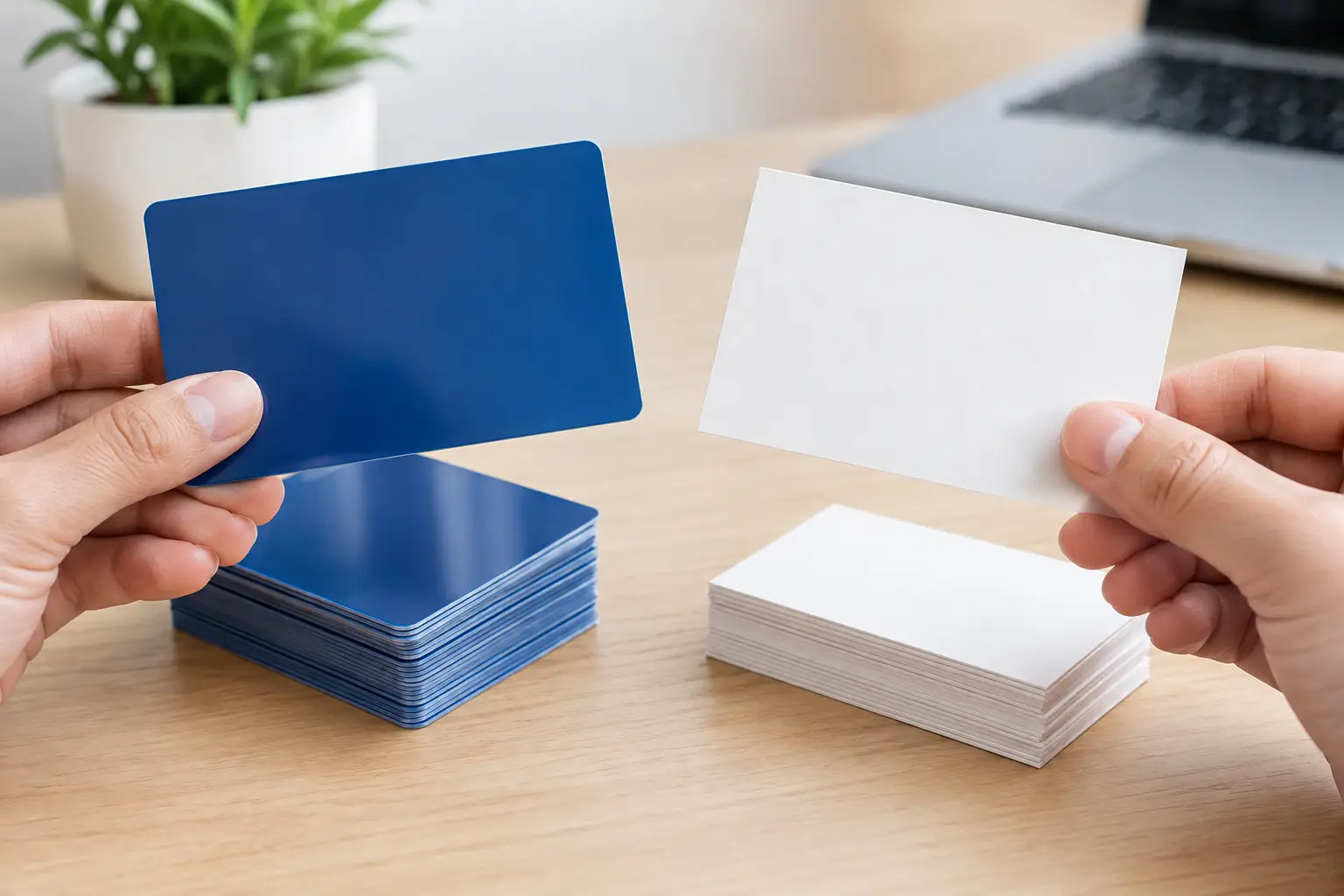
A business card that gets carried for months faces a different job than a flyer handed out at a weekend event. That is the practical difference behind PVC cards vs paper cards. Both can carry your logo, contact details, QR code, offer, or membership information, but they perform differently once they leave your counter.
Paper cards are familiar, affordable, and highly flexible for short-run marketing. PVC cards are made for repeat handling, moisture exposure, and a more permanent branded presence. The right choice depends on what the card needs to do, how often it will be used, and how much durability your customer experience requires.
PVC Cards vs Paper Cards: The Main Difference
PVC is a plastic material commonly used for ID cards, loyalty cards, membership cards, key tags, gift cards, and access cards. It has a smooth, rigid surface and is generally close to the thickness of a bank card. PVC cards do not crease easily, resist water, and hold up well in wallets, purses, lanyards, and point-of-sale environments.
Paper cards are printed on cardstock, with stock weight and finish selected according to the application. They can be uncoated, gloss laminated, matte laminated, velvet laminated, or enhanced with spot UV and embossing. Paper provides more finish options and can create a premium tactile impression, especially for business cards, appointment cards, invitations, and retail insert cards.
The material choice is not simply plastic versus paper. It is a decision between long-term function and print flexibility. A restaurant loyalty card used every week has different requirements than a consultant’s business card or a one-day event pass.
When PVC Cards Are the Better Buy
PVC cards are best when the card needs to remain in use for a long period. Their main advantage is durability. They withstand repeated handling without frayed edges, soft corners, or surface wear that can make a paper card look dated.
For customer retention programs, this matters. A loyalty card that stays clean and readable is more likely to remain in a customer’s wallet. A card with a barcode, QR code, or membership number also benefits from a stable surface that can be scanned repeatedly.
PVC is a strong option for these business uses:
- Membership and loyalty cards for salons, gyms, cafés, retailers, and service businesses
- Employee ID cards, visitor badges, and staff cards
- Gift cards and stored-value cards
- Event credentials, VIP passes, and season passes
- Hotel key cards, access cards, and parking cards
- Branded key tags for fitness centers, auto services, and local clubs
PVC also creates a more substantial first impression. For businesses selling premium services, a thick plastic membership card can signal that the program has value. A spa, private clinic, real estate agency, or corporate organization may prefer PVC because it feels more permanent than standard cardstock.
There are trade-offs. PVC cards usually cost more per piece than paper, especially for small quantities. They also offer fewer specialty print effects than paper cards. If your design depends on a soft-touch velvet finish, raised spot UV logo, foil-style effect, or textured stock, paper may be the stronger presentation material.
PVC Card Finishes and Print Considerations
Most PVC cards use full-color printing on one or both sides. White PVC is standard for bright color reproduction, while clear or frosted PVC can create a more distinctive look for select brand styles. Variable data printing can add unique names, card numbers, barcodes, or QR codes when each card must be individually identified.
Keep the layout functional. Small text, QR codes, and barcodes should have enough contrast and clear space for reliable scanning. Avoid placing critical details too close to the edge, punch hole, magnetic stripe area, or signature panel if those features are part of the specification.
For frequent-use cards, choose a finish that supports the purpose. A glossy face can make colors look vivid, while a matte surface may be easier to write on and may show fewer fingerprints. The best option depends on whether the card is meant to be displayed, scanned, signed, or carried every day.
When Paper Cards Make More Sense
Paper cards remain the most versatile choice for everyday business printing. They are cost-effective, easy to order in larger quantities, and available in many stock weights, sizes, shapes, and finishing options. For marketing pieces with a short working life, paper is usually the more efficient spend.
Business cards are the obvious example. Most professionals do not need a plastic card to share their number, email, and website. A well-printed 16 pt or 32 pt paper business card can look polished, feel substantial, and offer more design flexibility than a standard PVC card.
Paper is also the better choice when you need customers to write on the card. Appointment cards, referral cards, loyalty stamp cards, table reservation cards, and coupon cards work well on uncoated or writable matte stock. A glossy PVC card may look sharp, but it is not always practical for a handwritten date, stamp, or note.
Paper cards are particularly useful for promotional campaigns, direct mail inserts, product thank-you cards, trade show handouts, and seasonal offers. These items are often distributed in volume and replaced frequently. Spending extra on PVC may not improve results when the message is time-sensitive.
Paper Stock and Finish Options
Paper gives businesses more ways to match card design to brand positioning. A standard coated stock is a practical option for everyday cards and promotional pieces. Matte lamination creates a clean, low-glare appearance. Velvet lamination adds a soft-touch feel that works well for premium business cards, beauty brands, and professional services.
Spot UV can highlight a logo, name, or graphic against a matte background. Embossing adds physical depth. Rounded corners, die-cut shapes, and thicker stocks can help a paper card stand apart without moving to plastic.
These upgrades are useful when the card itself is part of the sales presentation. An architect, financial advisor, wedding vendor, luxury retailer, or creative studio may gain more from a distinctive paper finish than from PVC durability. The card is not only an information carrier. It is a sample of the brand’s attention to detail.
Compare Cost, Lifespan, and Use
The lower upfront price of paper does not automatically make it the lowest-cost option. If a paper loyalty card needs to be replaced often because it bends, gets wet, or becomes unreadable, a PVC card may offer better value over time. On the other hand, ordering durable plastic cards for a two-week promotional campaign can add expense with little return.
Consider the card’s expected lifespan. For a single event, a product launch, or a temporary discount offer, paper is usually sufficient. For a year-round customer program, employee identification, or recurring access requirement, PVC is often the more practical material.
Quantity also matters. Paper printing is generally more flexible for changing offers, small test runs, and frequent design updates. PVC is better suited to designs that will stay consistent, such as branded membership cards, standard employee IDs, or gift card programs.
How to Choose the Right Card Material
Start with the action you want the recipient to take. If they need to keep the card, scan it, present it repeatedly, or use it as proof of membership, PVC is the stronger choice. If they need to read an offer, book an appointment, receive a coupon, or remember your contact information, paper may be more appropriate.
Next, consider the environment. Cards used near water, food service counters, outdoor venues, gyms, vehicles, or high-touch retail stations benefit from PVC. Cards distributed at networking events, placed in packages, inserted into brochures, or handed out with receipts usually work well in paper.
Finally, match the material to the brand experience. A durable PVC card communicates permanence and utility. A heavyweight paper card with velvet lamination or spot UV communicates print quality and visual detail. Neither is automatically more professional. The better option is the one that supports the job of the card.
For businesses ordering multiple branded items, it can be efficient to keep paper business cards, flyers, and promotional inserts separate from PVC loyalty or ID cards. Seaonce can help keep those routine print requirements under one ordering process while allowing each item to use the material that fits its purpose.
A card should earn its place in a customer’s wallet, on a counter, or inside a package. Choose PVC when the card must last. Choose paper when design flexibility, writable space, and campaign value matter most.