

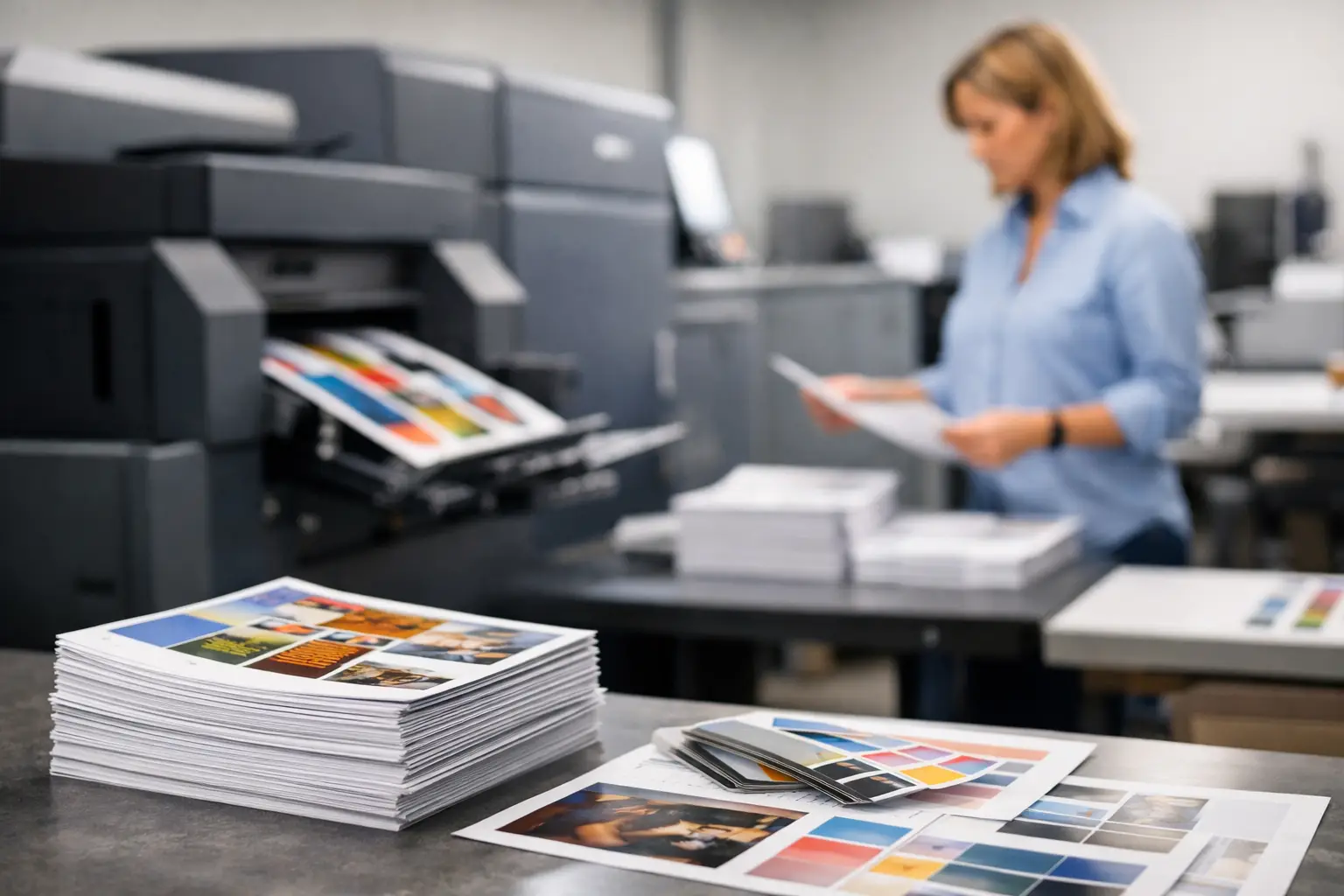
A startup orders business cards from one vendor, flyers from another, uniforms from a third, and a banner from a local shop. The pricing is scattered, the colors do not quite match, and reordering takes longer than it should. That is usually where commercial printing for small businesses becomes less of a marketing extra and more of a purchasing decision that affects daily operations.
Small businesses do not just need print. They need repeatable print, clear specifications, and a supplier that can handle routine office materials, promotional pieces, event graphics, and branded items without forcing them to manage five separate quotes. The real value is not only the finished product. It is the ability to order what you need, when you need it, in a format that fits your budget and your brand.
What commercial printing for small businesses usually includes
For most small companies, commercial printing starts with core paper products. Business cards, flyers, brochures, postcards, letterheads, invoices, NCR pads, certificates, and stickers are the standard items that support sales, administration, and customer communication. These are the products that get reordered often, so consistency matters.
Then there is large-format and display print. Banners, roll-up displays, posters, and storefront signage are common for retail shops, restaurants, events, trade shows, and service businesses. These products need a different production setup than paper stationery, but buyers still want the same thing – visible pricing, standard sizes, and quick order flow.
A lot of small businesses also need branded merchandise and apparel as part of the same purchase cycle. Staff uniforms, T-shirts, chef coats, caps, mugs, bags, key chains, trophies, and giveaway items sit in a different category from brochures, but they serve the same purpose. They put the brand in front of customers and keep presentation consistent.
That is why a broad catalog matters. A buyer may start with 16 pt business cards and end up needing die-cut stickers, a PVC loyalty card, and a branded tote bag for an upcoming event. Ordering across categories saves time and reduces procurement friction.
Why small businesses outgrow basic print shops
A local quick-print shop can still be useful for one-off jobs. But many small businesses eventually need a more structured commercial print source because the buying pattern changes. Instead of a single urgent order, they begin purchasing on repeat across multiple products and departments.
That is when details such as paper weight, coating, lamination, finish options, and package quantities become more important. A company ordering brochures every month does not want to explain the same specs each time. A restaurant replacing menus and stickers needs practical options that are easy to compare. An event organizer may need flyers, roll-up stands, lanyards, and branded shirts on the same timeline.
Commercial printing works better in that environment because it is built around standardized products and scalable fulfillment. The buyer gets more predictable pricing and fewer surprises, especially when ordering common SKUs with fixed sizes, stock options, and finishing upgrades.
Choosing print products by business need
The right mix depends on how the business operates. A service company usually starts with business cards, letterheads, invoices, NCR forms, and presentation folders because those products support sales meetings and customer paperwork. A retailer may put more budget into stickers, shelf signage, shopping bags, and promotional flyers. A restaurant may need menus, takeaway inserts, chef wear, and window graphics.
Startups often make the mistake of treating every product as equally urgent. In practice, some items drive day-to-day use while others are campaign-based. Business cards, receipts, forms, and basic signage are operational. Postcards, brochures, and giveaway items are promotional. Uniforms and packaging usually sit somewhere in the middle because they affect both brand presentation and customer experience.
It helps to buy in layers. First, secure the basics that customers and staff touch constantly. Then add event or promotional materials. After that, consider finish upgrades or branded merchandise where the return is visible.
Specs that change the result and the price
Print buyers often focus on quantity first, but specifications shape both cost and perception. Paper stock is one of the first decisions. Lighter GSM may suit flyers or inserts, while premium cards and certificates usually need heavier stock for a stronger hand feel.
Finish selection is where commercial print starts to look more polished. Matte lamination gives a smooth, subdued look. Gloss can increase color pop. Velvet lamination adds a soft-touch effect that works well on premium cards and covers. Spot UV highlights selected areas for contrast. Embossing adds texture and makes logos or names stand out.
These upgrades are useful, but they are not automatically the best option for every order. If a business reorders high-volume handouts weekly, a simpler finish may be more cost-effective. If the product is customer-facing and meant to create a strong first impression, premium finishing can justify the extra spend.
Material also matters beyond paper. PVC cards, synthetic labels, banner media, fabric, and sublimation-ready apparel each suit different use cases. A loyalty card that gets handled often needs more durability than a temporary event pass. An indoor roll-up display has different requirements than an outdoor banner.
The case for buying from one print source
One supplier will not solve every problem, but for many small businesses it solves the expensive ones. The biggest advantage is consolidation. Instead of managing multiple vendors for stationery, signage, apparel, and promotional goods, the buyer can work from one catalog and place orders in a more organized way.
That matters for consistency. Brand colors, logo use, product sizing, and print style are easier to maintain when more of the order volume sits in one place. It also matters for speed. A business owner or office administrator does not have time to chase separate quotes for stickers, brochures, and uniforms every month.
There is also a practical purchasing benefit. When pricing is visible and products are arranged by category, buyers can compare options faster. That is especially useful for repeat items such as postcards, brochures, NCR pads, and business cards, where the decision is often about stock, finish, and quantity rather than custom production from scratch.
For companies that need a broad range of print products, a catalog-driven supplier such as Seaonce fits the way many buyers already purchase – by product type, size, specification, and reorder frequency.
Common mistakes in commercial printing for small businesses
The first mistake is ordering based on unit cost alone. A lower-cost card or flyer may not hold up well enough for the actual use case. If the print looks weak or feels too light, the business may end up reordering sooner or missing the impression it wanted to make.
The second mistake is mixing too many styles across products. A premium spot UV business card paired with a low-grade flyer and an unrelated banner design can make the brand feel inconsistent. Not every product needs the same finish, but the visual system should still feel connected.
Another common issue is overordering on slow-moving items and underordering on operational ones. A company may stock too many branded giveaways while running short on invoices, labels, or business cards. Better print buying starts with usage patterns, not wish lists.
Finally, some businesses choose specialty finishes without thinking about function. Gloss looks sharp, but it may not be ideal for a surface that needs handwriting. Embossing adds impact, but it may not be worth it on a disposable handout. The best spec is the one that fits how the item is actually used.
How to make better print buying decisions
A practical approach is to divide your print needs into recurring, promotional, and event-based categories. Recurring products should be easy to reorder with fixed specs. Promotional items should support a specific campaign or sales goal. Event-based materials should be planned as a group so the signage, handouts, apparel, and giveaways work together.
It also helps to standardize where possible. Pick a business card format, a flyer size, a letterhead stock, and a label type that can stay consistent over time. Save premium finishes for the products where they add clear value. Keep artwork and specifications organized so reorders are straightforward.
Most small businesses do not need the most complex print setup. They need a dependable one. If the supplier offers broad product choice, clear finishing options, visible pricing, and a simple ordering path, that usually has more day-to-day value than chasing custom quotes across multiple sources.
Print still carries weight because customers hold it, staff use it, and prospects judge it quickly. When the products are chosen well, commercial printing stops being a patchwork expense and starts acting like part of the business infrastructure. Order the basics with intent, upgrade where it counts, and make reordering easier than the first purchase.