

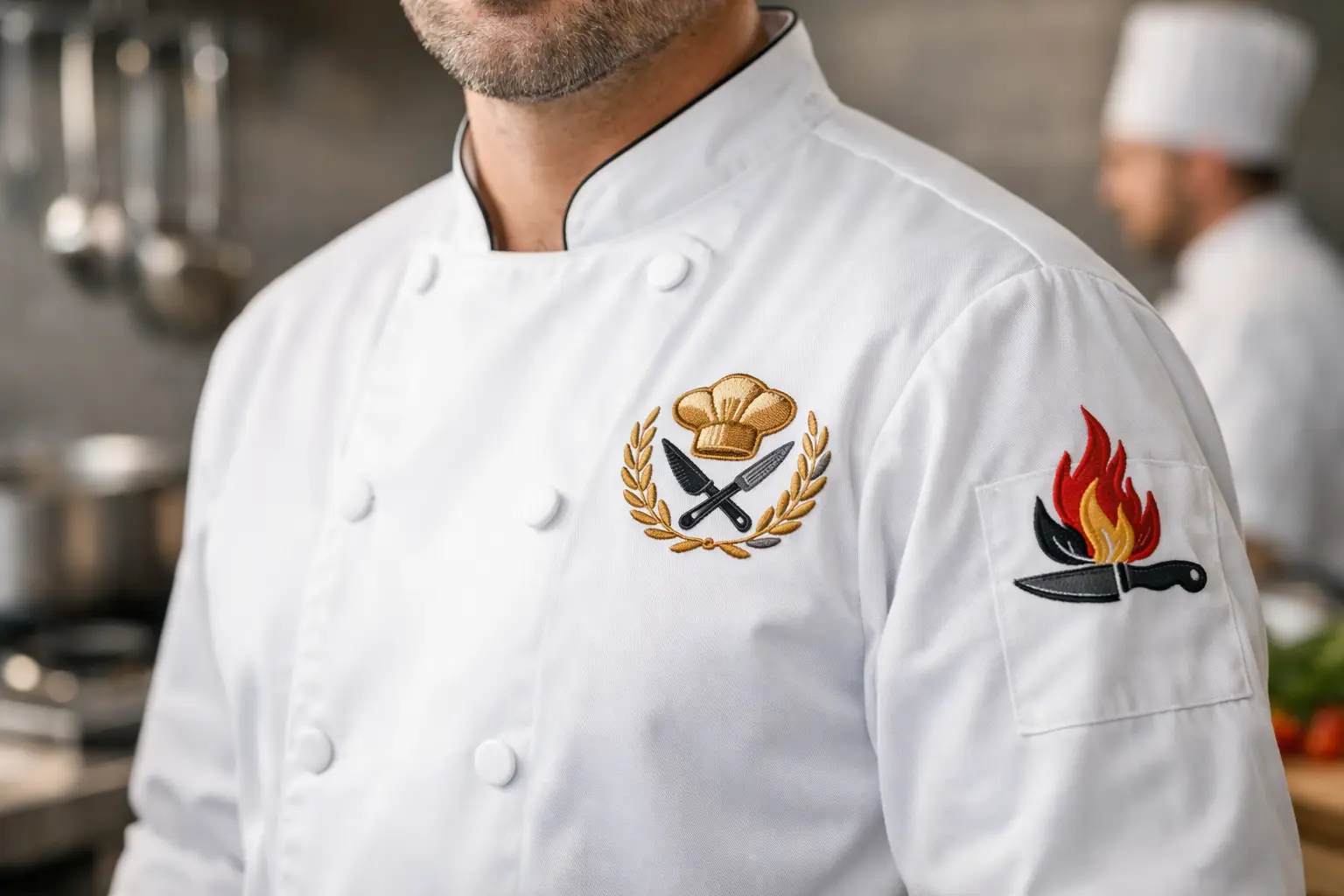
A chef coat gets judged fast. Before a guest tastes the food, they see the kitchen team, the uniform, and the level of detail. That is why custom chef coats embroidery matters for restaurants, caterers, bakeries, hotel kitchens, and food service brands that want a cleaner, more professional presentation.
Embroidery does more than add a logo. It turns a standard uniform into branded workwear that holds up through repeated washing, heat, and daily use. For buyers managing staff uniforms, the right embroidery setup helps with brand consistency, role identification, and a more organized front-of-house or open-kitchen appearance.
Why custom chef coats embroidery makes sense
Printed uniforms can work for some apparel categories, but chef coats deal with heat, grease, steam, and frequent laundering. Embroidery is usually the better fit because the stitched finish keeps its shape and gives the garment a more established, premium look.
For a restaurant owner, this is less about decoration and more about presentation. A left chest logo creates instant brand visibility. A name on the front helps customers identify chefs in live-service or exhibition kitchen settings. A sleeve detail can support a secondary mark, location branding, or rank. These are practical additions, not extras for the sake of appearance.
There is also a purchasing advantage. When uniforms look standardized across a team, the business feels more established. That can matter for independent restaurants trying to compete with larger chains, and for caterers who need staff to look coordinated across events.
What to include on custom chef coats embroidery
The most common embroidery choices are brand logo, employee name, job title, and small secondary marks. The right combination depends on how the coat will be used.
A single-location restaurant often keeps it simple with a chest logo and, in some cases, the chef’s name. Multi-location operations may add a branch identifier or department label. Catering companies sometimes prioritize the company name over individual names because staffing changes more often. Bakeries and pastry studios may prefer a cleaner logo-only layout if the look of the brand is more minimal.
The decision comes down to replacement cost, staff turnover, and the role of the garment in customer-facing service. Personalizing every coat with an employee name looks sharp, but it can reduce reuse when staff changes. If the team is stable, that trade-off may be worth it. If turnover is higher, generic branded coats are usually the better buy.
Logo placement options
The left chest remains the standard because it is visible, balanced, and professional. It works well for most restaurant logos, especially compact marks or wordmarks. Right chest embroidery is often used for the employee name or title, creating a clean two-sided layout.
Sleeve embroidery can be useful, but only if the design is simple. Small logos, flag icons, or short text work better there than detailed artwork. A large back embroidery is possible on some chef coats, though it depends on the fabric weight, garment style, and whether the brand actually needs that much visibility. For most kitchens, front placement is enough.
Names and titles
Adding names is a functional choice in open kitchens, hospitality venues, culinary schools, and events where guest interaction matters. Titles such as Executive Chef, Sous Chef, Pastry Chef, or Kitchen Manager can also help define hierarchy.
That said, titles should be used carefully. In a small team, title embroidery can help clarify roles. In a fast-changing operation, it may create more reorder complexity than necessary. A simpler format with logo plus first name is often easier to maintain.
Choosing the right thread and design setup
Not every logo translates cleanly to embroidery. Fine lines, tiny lettering, gradients, and highly detailed artwork may need to be adjusted before production. What looks sharp on a business card or flyer may not stitch well on a textured garment.
For custom chef coats embroidery, bold shapes and readable text usually perform best. If the logo includes very small details, simplifying the artwork can improve the final result. This is especially true on smaller chest placements, where clarity matters more than trying to reproduce every element.
Thread color should also be selected with the coat color in mind. White thread on a light gray coat may not give enough contrast. Black thread on a dark navy coat can disappear under lower lighting. High-contrast combinations tend to look cleaner and remain readable at a distance.
There is a visual trade-off here. Tone-on-tone embroidery can look premium and understated, but it reduces visibility. Contrast embroidery is stronger for branding and identification. The right option depends on whether the goal is subtle presentation or easy recognition.
Fabric, coat style, and wear conditions
Chef coats are not all built the same. Some are lightweight for hot kitchen environments, while others are heavier and more structured for formal dining or executive presentation. Fabric content and garment construction affect how embroidery sits on the coat.
A sturdier coat generally supports embroidery better, especially for larger logos or denser stitching. Lightweight materials can still be embroidered, but design size and stitch count may need to be controlled to avoid puckering or stiffness. This is one reason simple, compact artwork is often the safer choice.
Button style, pocket position, sleeve construction, and vent details also matter. A chest logo should not crowd a seam or overlap functional garment features. If the coat includes a thermometer pocket or a specific panel construction, embroidery placement may need to shift slightly for a cleaner finish.
For buyers ordering at scale, this is where a product-focused supplier helps. Garment style and branding setup should be considered together, not treated as separate decisions.
Ordering for one location or multiple teams
A small restaurant may only need a few embroidered coats for kitchen leadership. A catering group, hotel, commissary kitchen, or restaurant chain may need multiple sizes, role variations, and repeat ordering over time.
That changes how you should approach the order. For smaller teams, fully personalized embroidery often makes sense. For larger operations, standardization becomes more important. It is usually more efficient to lock in one approved logo size, one or two placement options, and a limited thread palette. That keeps reorders consistent and reduces approval issues later.
If multiple departments are involved, such as bakery, prep, line, and management, embroidery can support internal organization. Different titles or sleeve identifiers may help. But too many variations can slow purchasing and complicate inventory. In many cases, one master logo format plus selective name personalization is the best balance.
Businesses that already source printed materials, signage, and branded apparel from one place often benefit from keeping uniforms in the same workflow. A supplier with broad catalog coverage, like Seaonce, can simplify repeat business purchasing when uniforms need to align with menus, packaging, event materials, and day-to-day brand collateral.
Common mistakes to avoid
The biggest mistake is using artwork that is too detailed for embroidery. The second is choosing placement without considering how the coat is actually worn in service. A logo that looks centered on a flat mockup may sit awkwardly once the coat is buttoned and moving.
Another issue is over-personalizing every garment without thinking about replacement cycles. Named uniforms look polished, but they are less flexible for future staffing changes. Ordering too many unique versions upfront can lead to waste.
It is also easy to choose thread color based only on brand guidelines and ignore garment contrast. Brand accuracy matters, but readability matters too. If the stitched logo cannot be seen clearly from a few feet away, the branding is not doing its job.
Finally, do not treat chef coats like standard promo apparel. Kitchen garments have a different job. They need to look professional, wear well, and stay presentable after repeated washing. Embroidery choices should support that reality.
How to buy custom chef coats embroidery with fewer problems
Start with the garment purpose. Is this for customer-facing chefs, back-of-house staff, culinary students, or event service teams? Then decide whether the coat needs only a logo or also names and titles. After that, review the artwork for stitch suitability, choose high-contrast thread colors, and confirm the exact placement on the coat style being ordered.
If the order is for a team, think beyond the first batch. Ask whether future reorders will need the same logo size, the same thread colors, and the same personalization format. The easier it is to repeat the order, the easier it is to keep branding consistent.
A chef coat is a working uniform, but it is also part of how a food business presents itself. Clean embroidery, smart placement, and practical ordering choices can make the difference between a coat that simply fills a requirement and one that actually supports the brand every day.