

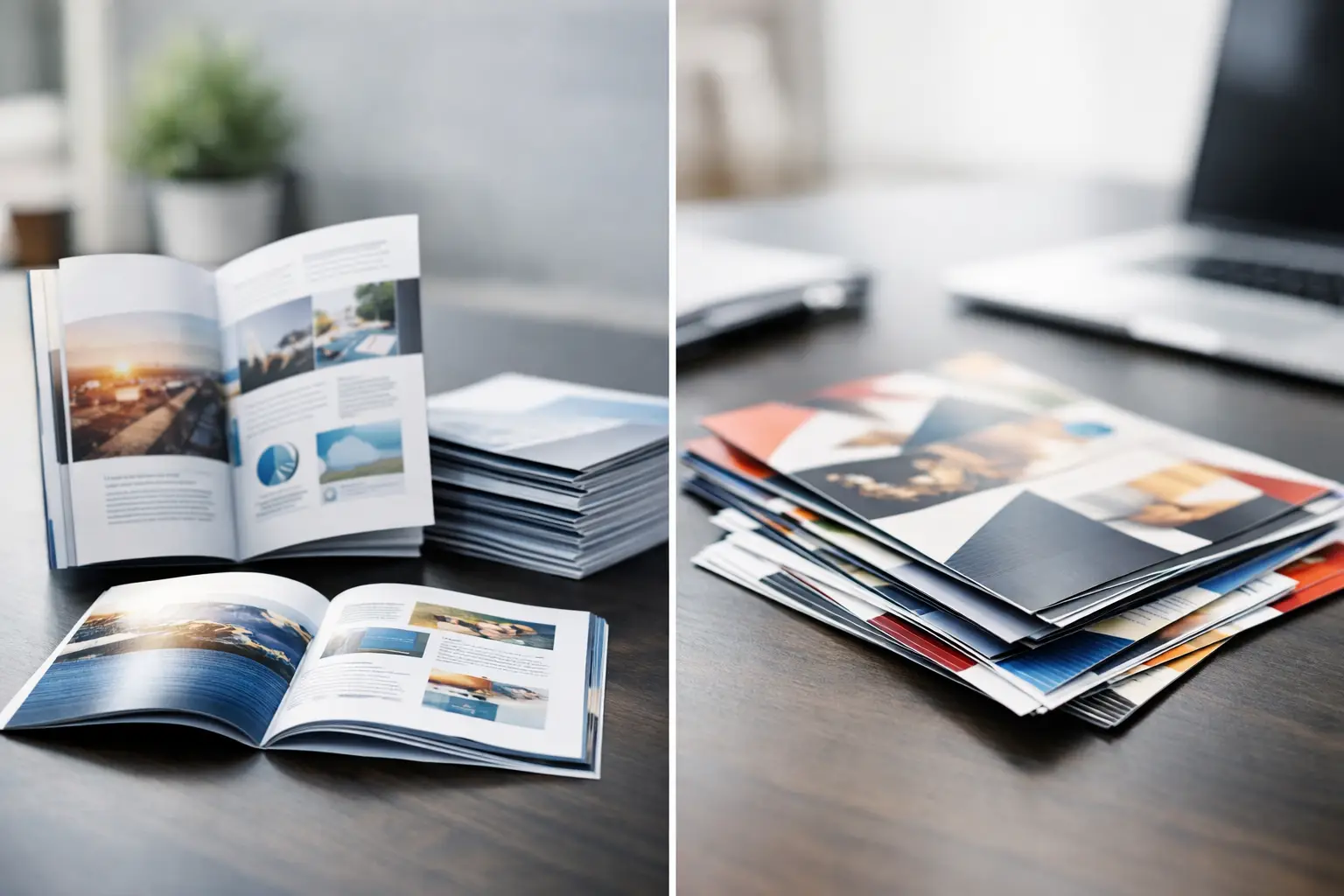
Brochures vs flyers is a practical print decision that affects your budget, message, and how customers respond. A restaurant promoting a lunch special does not need the same printed piece as a contractor explaining service packages or a real estate agent presenting a property. The right choice depends on how much information you need to communicate and where the piece will be handed out, displayed, mailed, or inserted.
A flyer is built for speed. It delivers one offer, event, announcement, or call to action in a format people can scan in seconds. A brochure gives your business more room to explain products, services, pricing, features, and contact details in an organized layout. Both can be effective, but using the wrong format can make a simple promotion feel crowded or make a detailed sales message feel incomplete.
Brochures vs Flyers: The Core Difference
The main difference is structure. Flyers are usually single-sheet promotional pieces, printed on one or both sides. They are commonly ordered in standard sizes such as 4 x 6 inches, 5 x 7 inches, 8.5 x 11 inches, and 11 x 17 inches. Their job is to get attention quickly and encourage an immediate next step, such as visiting a store, calling for a quote, scanning a QR code, or attending an event.
Brochures are generally folded sheets. Common options include bi-fold, tri-fold, Z-fold, gate fold, and half-fold formats. Folding divides the page into panels, creating a natural order for your content. The cover catches attention, inside panels explain the offer, and the final panel provides contact information or a clear call to action.
Choose a flyer when the message can be understood in a few seconds. Choose a brochure when the customer needs more context before they are ready to buy, book, visit, or request information.
When a Flyer Is the Better Print Product
Flyers work best for short campaigns and high-volume distribution. They are cost-effective, fast to design, and easy to place on counters, hand out at events, include in shopping bags, or distribute locally. For many small businesses, flyers are the right starting point because they keep the marketing message focused.
A flyer is a strong choice for a grand opening, limited-time sale, seasonal promotion, menu special, concert, workshop, fundraiser, new product launch, or coupon campaign. A gym might use a 5 x 7 flyer to promote a free trial. A salon can use an 8.5 x 11 flyer for a package offer. A retail store can print a double-sided flyer with featured products on one side and a discount code on the other.
The trade-off is limited space. A flyer should not try to carry your full company profile, detailed service explanations, staff biographies, terms and conditions, and product catalog all at once. When too much copy is added, the main offer gets buried.
What to Include on a Flyer
Start with one strong headline. Then show the offer, a relevant product image or service visual, the deadline if there is one, and one action for the customer to take. Your logo, phone number, website, address, and social media details can support the design, but they should not overpower the main message.
For local distribution, a map, store location, or neighborhood reference can be useful. For events, include the date, time, venue, ticket details, and a contact method. If you use a QR code, leave enough clear space around it so it scans reliably after printing.
When a Brochure Makes More Sense
Brochures are designed for considered purchases. They give customers a physical reference they can take home, review later, and share with another decision-maker. This makes them suitable for businesses selling services or products that need explanation before a customer commits.
A tri-fold brochure works well for medical clinics, insurance offices, travel agencies, schools, home improvement companies, cleaning services, financial consultants, and corporate service providers. Restaurants can use folded brochures for catering menus. Hotels and venues can use them for package options. Manufacturers and wholesalers can use them to introduce product ranges without printing a full catalog.
Brochures also make sense at trade shows, sales meetings, reception areas, and client presentations. A salesperson can use the panels as a conversation guide instead of relying on a long verbal explanation. The prospect leaves with the same key points, brand colors, product images, and contact details.
Plan the Panels Before Designing
A fold creates reading order, so brochure content needs planning. The front panel should work as a cover with your business name, logo, core offer, and a clean visual. The inside panels should explain the benefits, services, process, or product categories. Use the back panel for contact details, operating hours, location, social handles, a QR code, or a final call to action.
Avoid placing small text, faces, prices, or important logo elements directly on fold lines. Allow safe margins and keep critical content inside the trim area. A brochure may have more space than a flyer, but it still needs white space. Dense panels are difficult to read and can make a professionally printed piece look unorganized.
Paper Stock and Finish Change the Result
Paper choice should match the purpose of the piece. For short-term flyer campaigns, 100 lb gloss text or a comparable lightweight coated stock is a practical option. It produces bright colors, keeps costs manageable, and works well for bulk distribution. Matte stock is useful when the design contains a lot of text or when customers may need to write on the flyer.
For brochures, many businesses choose 100 lb or 120 lb text stock because it folds more cleanly than heavy cardstock while still feeling substantial. A heavier stock can communicate quality, but it must be suitable for the fold type. Thick paper can crack along the crease if it is not scored correctly.
Gloss lamination adds shine and helps colors stand out, which can suit product promotions, restaurant images, and retail campaigns. Matte or velvet lamination gives a softer, more premium finish for corporate brochures, beauty brands, property marketing, and presentation materials. Spot UV can highlight a logo, headline, or product image, but it works best when used selectively rather than across every element.
Compare Cost by Campaign Goal, Not Unit Price Alone
Flyers usually have a lower unit cost because they use less paper, require no folding, and are quick to produce in quantity. If you are distributing 5,000 pieces for a weekend promotion, a flyer is usually the practical choice. Its value comes from reach and repetition.
Brochures cost more per piece because they require a larger printed sheet and folding. However, they may produce better results when each prospect has a higher value. A $10 discount coupon and a commercial cleaning contract should not be marketed with the same level of detail. If one qualified customer can generate recurring revenue, the added cost of a brochure may be justified.
Think about how long the printed piece needs to work. A flyer for a three-day sale can be disposable by design. A brochure for a law firm, clinic, or construction company may remain at a reception desk or in a customer folder for months. Print quantity, stock, finish, and distribution method should follow that timeline.
Design for the Way People Will Receive It
A flyer handed out on a busy sidewalk needs a bold headline, high contrast, and a message visible at arm’s length. It should answer the customer’s first question immediately: What is this, and why should I care? Large pricing, a clear offer, or an event date can do that job.
A brochure picked up in an office or handed over during a consultation can use more explanatory copy. Even then, keep paragraphs short, use readable font sizes, and lead with benefits rather than internal company descriptions. Customers want to know what you provide, who it is for, what makes the offer useful, and how to proceed.
Use consistent branding across both formats. Your logo, color palette, fonts, product photography, and contact details should match your business cards, signage, menus, packaging, and other branded materials. Ordering related print products from one supplier, such as Seaonce, can help maintain consistent specifications across recurring campaigns.
Make the Print Choice Before You Start the Artwork
The fastest way to choose is to write your message in one sentence. If the sentence is a single offer with one action, print a flyer. If the sentence needs follow-up questions, service details, comparisons, or a step-by-step explanation, print a brochure.
You can also use both. Send or hand out a flyer to create immediate attention, then keep brochures at your counter, event booth, or sales desk for prospects who want more details. This approach works especially well for restaurants, training centers, retail launches, home services, and event businesses.
Before placing an order, check the final size, fold type, paper stock, finish, quantity, and delivery deadline. A clear message on the right format will do more for your campaign than extra design elements ever will.