

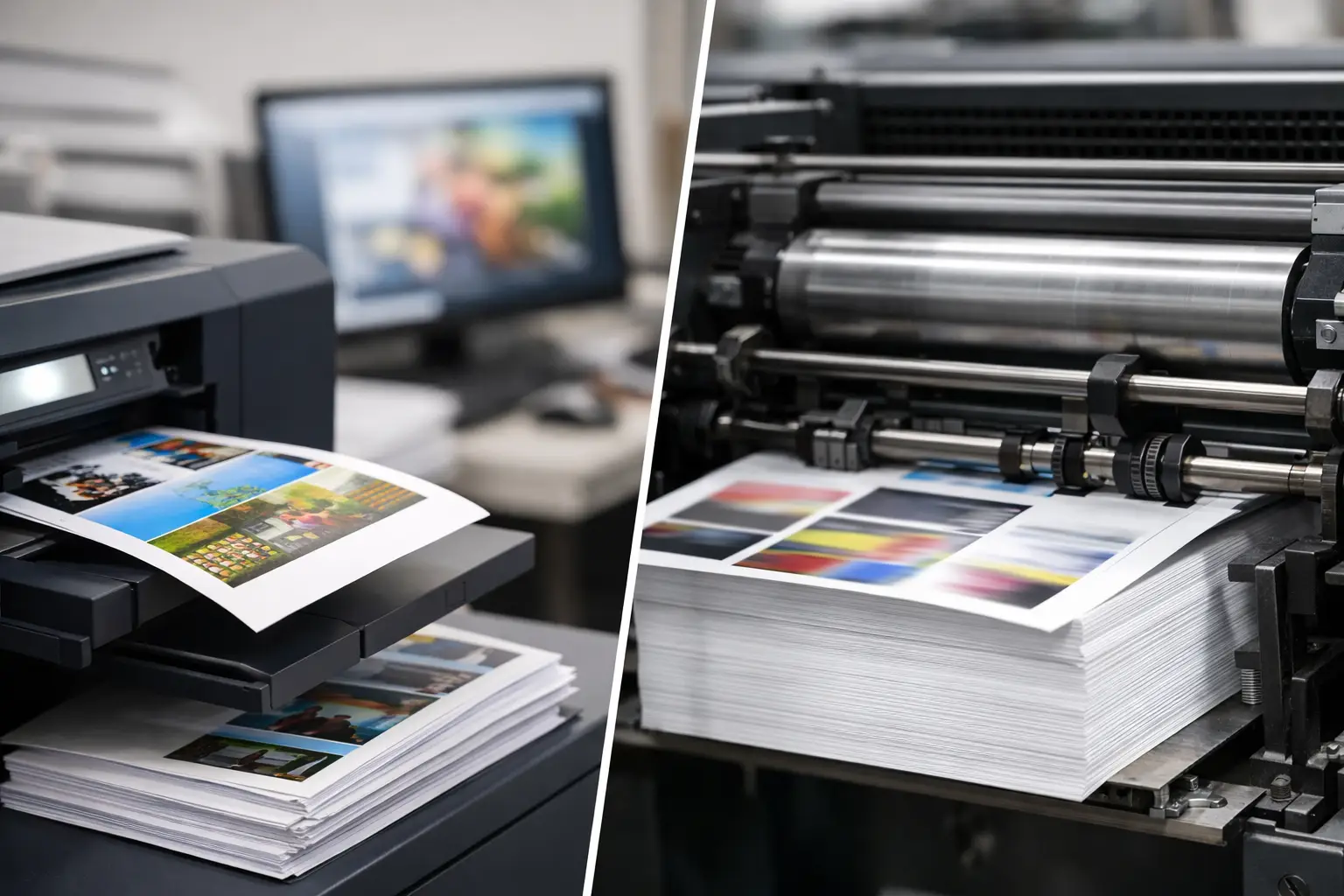
A 100-card business card order needed for a meeting next week should not be produced the same way as 25,000 promotional flyers for a citywide campaign. The decision between digital printing versus offset printing affects unit cost, turnaround time, color consistency, available materials, and the finishes your job can support. For most business buyers, the right choice starts with quantity and deadline, then moves to paper, color, and presentation.
Digital Printing Versus Offset Printing: The Core Difference
Digital printing sends your artwork directly from a digital file to the press. There are no printing plates to create, so setup is fast and short runs are economical. It is a practical choice for business cards, postcards, flyers, menus, stickers, certificates, short-run brochures, and variable-data pieces such as numbered forms or personalized mailers.
Offset printing transfers ink from metal plates to a rubber blanket and then onto paper or another substrate. The setup takes longer because plates must be prepared and the press calibrated. Once production is running, however, offset becomes highly cost-effective at larger quantities and delivers strong color control across long runs.
Neither process is automatically better. A restaurant replacing 50 menus after a price update has different requirements from a retailer ordering 10,000 grand-opening flyers. Printing method should follow the job, not just the product name.
When Digital Printing Is the Better Buy
Digital printing is built for speed, flexibility, and smaller order quantities. Because there is little setup time, it is often the best route when you need finished materials quickly or when the artwork may change before the next order.
For example, a startup may need 250 business cards for a new team, 100 branded folders for a sales presentation, and 500 event flyers with a date that cannot move. Digital production keeps these lower-volume jobs efficient without the plate charges associated with offset work. It also makes reordering simple when a phone number, promotion, employee name, or QR code changes.
Variable data is another major advantage. Each printed piece can contain different information without stopping the press. This is useful for sequentially numbered invoices, NCR pads, certificates, direct mail pieces with individual names, and event badges. Offset can handle numbering and personalization through additional processes, but digital printing is usually more direct for these applications.
Digital is also a sensible choice for test runs. Before committing to a large brochure, packaging insert, or postcard campaign, order a short quantity to check the copy, images, paper feel, and response. Finding a spelling error on 100 pieces is far less costly than finding it on 20,000.
Best-fit digital jobs
Digital printing is commonly selected for short-run business cards, flyers, postcards, menus, letterheads, presentation materials, certificates, short-run catalogs, and on-demand promotional cards. It is especially useful when the quantity is low, the turnaround is tight, or each item needs different names, codes, or numbers.
Paper and finishing options vary by press and product. Many professional digital jobs can still be produced on quality card stocks with matte, gloss, or velvet lamination. Ask about the specific stock, GSM, trim size, and finishing method rather than assuming every finish is available on every digital format.
When Offset Printing Makes More Sense
Offset printing earns its place on high-volume jobs. The initial setup cost is higher, but it is distributed over the full quantity. As the run grows, the cost per brochure, flyer, catalog page, or postcard can become lower than a comparable digital order.
This matters for businesses that distribute print at scale. A local store chain planning a 15,000-piece coupon drop, an event organizer producing thousands of programs, or a corporate office ordering recurring letterheads may benefit from offset production. It is also a strong option when a job requires exact brand colors or large areas of consistent color.
Offset presses can use Pantone spot colors in addition to standard CMYK inks. That gives greater control when a logo color must match a brand guide closely, particularly across multiple printed items and repeat orders. Digital presses reproduce many colors very well, but their output is usually built around a fixed toner or ink set. If color matching is a contractual requirement, specify Pantone references and ask which production method will be used.
Offset is often preferred for premium stationery, long-run brochures, product inserts, booklets, and marketing campaigns that need a traditional ink-on-paper appearance. It can also accommodate a broad range of paper stocks and specialty processes, depending on the press configuration and finishing equipment.
The quantity break-even point is not fixed
There is no universal number where offset becomes cheaper. The break-even point depends on size, number of colors, paper stock, page count, finishing, and press availability. A one-color letterhead may shift to offset at a different quantity than a full-color, folded brochure with spot UV.
Instead of choosing by a rule such as “offset is for 1,000 pieces,” compare quotes for your exact specifications. Include the finished size, stock weight, number of sides, color requirements, fold type, lamination, die cutting, embossing, and delivery date. The lowest base print price is not always the lowest finished-job cost.
Compare Cost, Speed, Color, and Finish
For short runs, digital printing typically has a lower total cost because it avoids plate setup. For larger runs, offset often offers a lower unit price. If your order will be distributed over several months, consider whether you need the full quantity now. Ordering fewer pieces digitally can prevent waste if pricing, contact details, or campaign messaging are likely to change.
Digital production is generally faster from approved artwork to press. That makes it suitable for last-minute event materials, replenishment orders, and quick promotions. Offset requires more prepress preparation and can take longer, especially if the job includes special inks or complex finishing. A realistic schedule should also allow time for proof approval, cutting, folding, binding, lamination, and shipping or pickup.
Color is a more detailed decision than “digital versus offset.” Both methods can produce professional full-color marketing materials. Offset has the advantage when precise Pantone matching, dense color coverage, or tight consistency across a very long run is the priority. Digital is effective for most everyday branding work, particularly when artwork is prepared correctly in CMYK and images are high resolution.
Finishing can change the decision as much as the print process. Velvet lamination creates a soft, premium surface for business cards, folders, and packaging pieces. Spot UV adds contrast by placing gloss on selected areas such as a logo or headline. Embossing provides a raised tactile detail. Die cutting can create custom sticker shapes, hang tags, or unusual card silhouettes. These options may be available with either process, but they add separate production steps, lead time, and cost.
Choose the Print Method Before You Upload Artwork
A clean file prevents delays regardless of press type. Set artwork to the final trim size with the required bleed, use high-resolution images, convert colors to the requested mode, and keep important text away from the cut line. If your job has folding, create panels to the correct folded dimensions rather than treating the piece as a single flat page.
For brand-critical work, provide approved logo files and Pantone references where applicable. Avoid judging color from an uncalibrated screen. A monitor can make blue appear more vivid or gray appear warmer than the finished printed piece. If the job is a large campaign, a proof or sample can be a worthwhile safeguard.
Also consider how the item will be used. A takeaway menu needs readable type and a durable finish. A real estate flyer may need sharp property photography. An outdoor sign needs a material and ink system suited to weather exposure, which is a separate consideration from standard paper printing. Apparel, mugs, banners, PVC cards, and promotional products use different print technologies altogether, so do not apply a paper-printing rule to every branded item.
A Practical Buying Decision
Choose digital printing when you need a short run, fast turnaround, frequent artwork changes, or personalization. Choose offset printing when quantity is high, unit cost matters most, exact brand color is essential, or the job calls for a particular stock and finish suited to offset production.
If the job sits in the middle, request pricing both ways with identical specifications. Seaonce customers often order routine short-run materials as needed while reserving larger campaigns for quantities where the per-piece savings justify offset setup. The most useful question is not which method is best in general. It is which method delivers the right quantity, finish, color control, and delivery date for the materials your business needs next.