

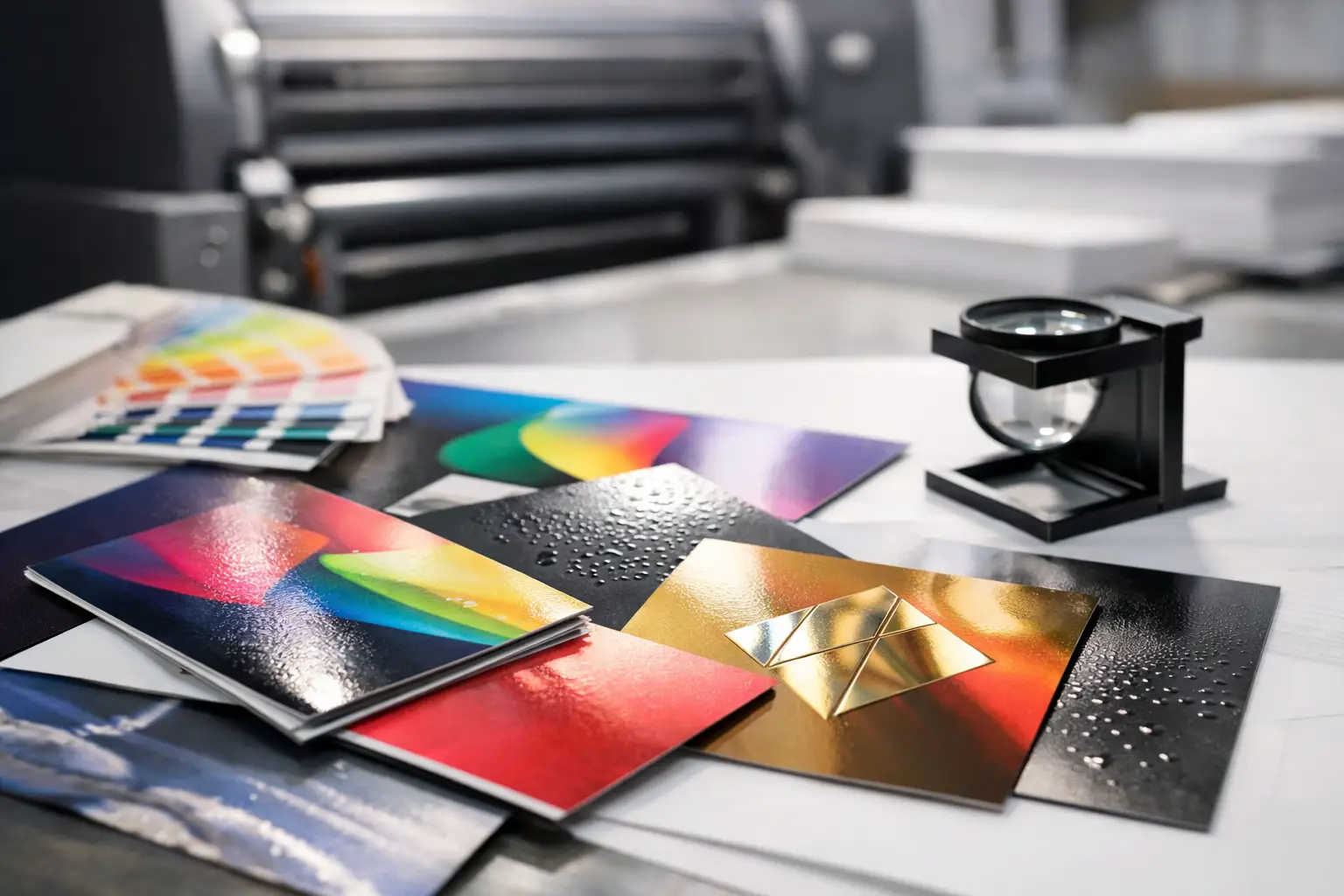
A business card can be printed on premium stock and still feel ordinary if the finish does not support the design. The same applies to brochures, menus, postcards, stickers, folders, and product packaging. This guide to commercial print finishes helps you choose the surface treatment, texture, and detail work that make a printed item look professional while staying within the right budget.
A finish is not only a decorative extra. It affects how color appears, how the piece feels in hand, how well it handles moisture and fingerprints, and whether key brand details stand out. The best option depends on the product, the amount of handling it will receive, the artwork, and the impression you need to create.
Start With the Job, Not the Finish
Before selecting gloss, matte, velvet, spot UV, or embossing, consider where the printed item will be used. A restaurant menu, for example, needs more protection than a one-time event flyer. A luxury business card may need a tactile detail that a high-volume direct-mail postcard does not.
Think about the main purpose of the item. Is it meant to be handed out quickly, displayed at a counter, mailed, used repeatedly, or kept as a premium brand piece? A finish should support that use rather than add cost without a clear benefit.
Paper stock also matters. Heavy card stocks give business cards, postcards, certificates, and presentation folders more weight. Lighter stocks are often appropriate for flyers, letterheads, inserts, and folded brochures. A premium finish can improve many stock types, but it cannot fully compensate for choosing a paper weight that does not match the job.
Guide to Commercial Print Finishes: Core Options
Most commercial print orders begin with a choice between an uncoated surface, a standard coating, or lamination. Each creates a different result and has a different practical use.
Uncoated stock
Uncoated paper has a natural, non-shiny surface. It is easy to write on, which makes it a practical choice for letterheads, forms, invoices, NCR pads, appointment cards, and certificates. It also works well when a softer, traditional, or understated brand appearance is preferred.
Because uncoated paper absorbs ink more than coated stock, colors may look less vivid than they do on gloss paper. It can also show dirt or moisture more easily. For pieces that need handwritten notes, stamps, or signatures, that trade-off is usually worth it.
Gloss coating and gloss lamination
Gloss creates a smooth, reflective surface that makes photographs and saturated colors appear sharper and more vibrant. It is commonly used for flyers, promotional postcards, product sheets, menus, catalogs, and image-heavy brochures.
Gloss lamination adds a protective plastic film over the printed sheet. It improves durability and helps resist scuffs, splashes, and regular handling. This makes it a strong option for restaurant menus, price lists, loyalty cards, event handouts, and frequently used cards.
The limitation is glare. Small text can be harder to read under bright lighting, and gloss may not suit brands that want a restrained or premium look. It is also not ideal when customers need to write directly on the printed surface.
Matte lamination
Matte lamination has a smooth, low-shine appearance. It reduces glare and gives colors a more controlled, refined look. It is often selected for corporate brochures, premium postcards, business cards, branded folders, packaging sleeves, and presentation materials.
Matte is a reliable all-purpose choice when you want protection without a glossy finish. Dark, solid-color designs can show fingerprints more easily on some matte surfaces, especially black, navy, and deep charcoal artwork. If the design uses large dark areas and will be handled often, consider velvet lamination or test the finish before placing a large run.
Velvet lamination
Velvet lamination, sometimes called soft-touch lamination, creates a smooth surface with a noticeably soft feel. It is designed for premium business cards, invitation cards, luxury packaging, high-end menus, and brand materials where the physical experience matters.
This finish gives simple designs more presence. A black business card with a minimal logo can feel substantially more expensive with velvet lamination than with standard gloss or matte. It does cost more, and it is best used on products where customers will notice the tactile difference. For a mass flyer that may be read once, the extra investment is usually unnecessary.
Use Specialty Finishes to Direct Attention
Specialty finishes work best when they are selective. They should draw the eye to a logo, product image, title, pattern, or call to action instead of covering every available surface.
Spot UV
Spot UV is a clear, glossy coating applied only to selected areas. On a matte or velvet laminated card, it creates contrast that makes a logo, headline, icon, or pattern catch the light. It is a popular choice for premium business cards, postcards, folders, packaging, and presentation covers.
For the strongest effect, use spot UV over bold shapes, thick lettering, or simple graphic elements. Very small type and fine lines may not show the effect clearly. Spot UV also needs clean artwork setup, including a separate mask layer that identifies the areas receiving the coating.
Embossing and debossing
Embossing raises part of the printed design above the paper surface. Debossing presses an element into the stock. Both add dimension and are commonly used for logos, monograms, seals, certificates, invitation cards, premium folders, and luxury packaging.
These finishes are most effective with simple artwork. A detailed illustration can lose clarity when raised or pressed into paper. Stock selection is also important because heavier card stocks generally produce a more noticeable result. Embossing may be paired with foil or spot UV, but adding multiple premium treatments can push the cost beyond what a routine print piece needs.
Foil details
Foil applies a metallic finish to selected artwork. Gold and silver are familiar options, but other foil colors may be available depending on the product specification. Foil is a strong fit for award certificates, upscale business cards, event stationery, product packaging, and limited-edition promotional items.
Use foil for a focal detail rather than long paragraphs or dense graphics. It is designed to create contrast and perceived value. A small foil logo on a velvet laminated business card often has more impact than a full card covered in competing effects.
Match the Finish to the Print Product
A finish should be chosen at the product level. One brand may use different treatments across its print materials without looking inconsistent.
Business cards benefit from heavier stock and a finish that matches the brand position. Matte or velvet lamination works well for consultants, creative studios, real estate professionals, salons, and premium service businesses. Spot UV or embossing can add emphasis to a logo. PVC cards are worth considering for membership cards, loyalty cards, ID cards, and any card that needs added durability.
Brochures and flyers need readability first. Gloss works well for product photos, food images, retail promotions, and travel-style visuals. Matte is better for text-led corporate material or designs with a quieter color palette. A folded brochure that will be mailed or stored should use a finish compatible with clean folding to reduce the risk of cracking along the crease.
Menus, price lists, and table cards often need lamination because they are exposed to food, moisture, and repeated cleaning. Gloss offers easy visual impact, while matte can suit a more upscale restaurant or café concept. For outdoor or high-contact applications, confirm the material and finishing specifications instead of assuming standard paper lamination is enough.
Stickers require a different decision process. The main question is usually not gloss versus matte alone, but whether the sticker material matches the application. Paper stickers are suitable for many indoor labels and packaging uses. Vinyl or PVC-based options are better for moisture, handling, and certain outdoor conditions. Die-cut shapes can help a sticker stand out, but complex cuts should leave enough border around critical artwork.
Prepare Artwork for a Clean Finished Result
Finishes can highlight good design, but they can also expose setup errors. Keep text away from trim edges, include bleed where required, and use high-resolution images. Small type should be large enough to remain readable after printing and finishing.
When using spot UV, foil, embossing, or die-cut shapes, avoid placing important content too close to the finished edge. Registration can have minor production tolerance, so a tight border or tiny detailed effect may look uneven. If your file includes black backgrounds, use the recommended rich black values for the product rather than relying on a default office-document black.
Also review the proof at actual size. A logo that looks large on a computer screen may be too small to make an embossing or spot UV effect noticeable on a standard business card. If the design is intended for a premium finish, simplify it before adding more visual elements.
Balance Cost, Quantity, and Brand Impact
The most expensive finish is not automatically the best one. A large run of promotional flyers may produce better results with quality gloss stock and clear artwork than with a specialty treatment that adds little to response rates. On the other hand, a small quantity of client-facing business cards can justify velvet lamination and spot UV because every card supports a personal sales conversation.
Use premium finishes where touch, retention, and perceived value matter. Use durable protective finishes where the item will be handled repeatedly. For routine office forms and writable stationery, keep the specification practical with uncoated stock and clear print.
Seaonce offers print products across everyday business stationery, marketing collateral, stickers, signage, and branded materials, making it easier to apply the right finish to each part of a campaign. Start with the product’s real use, then select the finish that gives customers a reason to keep it, use it, or remember your brand.